For international families drawn to northern Italy, Milan usually sets the benchmark: cosmopolitan, fast-moving, full of energy, and tied to fashion and design. Seen from outside, it looks effortless and fascinating. Lived day after day, however, the balance shifts—higher everyday costs, tighter living quarters, constant traffic or transit friction and a pace that rarely lets up.
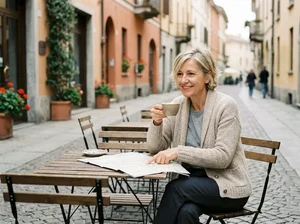
A town like Crema offers a very different balance, especially for families with children and teenagers. Where a big city demands constant logistics and can make everyday autonomy harder for younger kids, a smaller historic town works well across age groups—with schools at different levels and day-to-day life that feels manageable rather than compressed. Most daily errands and school runs happen on foot or by bike—wicker baskets and an unhurried vasca (the traditional stroll along the main street) for coffee or bread are simply part of how locals move—and the center stays lively from early morning until late evening before settling into a calm, quiet night. Even the occasional wave of visitors drawn by Call Me by Your Name taking photos with a gelato feels like a passing layer over a town that remains firmly anchored in everyday life.
Choosing the smaller town does not mean giving up Milan; it changes how you use it. At roughly forty minutes by train or half an hour by car, a dinner near the Galleria or an afternoon around Via Montenapoleone stays entirely possible—without carrying the weight of the city back into your daily routine.
Milan will always draw people in, and rightly so. Yet for many families, the most sustainable way to enjoy it is from a thoughtful distance—where everyday life has room to breathe.